Schedules and Serializability
What is a Schedule?
When multiple transactions are executed concurrently, their instructions are interleaved. A Schedule is simply a sequence of instructions that specifies the chronological order in which the instructions of concurrent transactions are executed.
- A schedule must consist of all instructions from the participating transactions.
- It must preserve the order in which the instructions appeared in their original transactions.
Serial vs. Concurrent Schedules
- Serial Schedule: Transactions run one after the other. Transaction A finishes completely before Transaction B begins. This guarantees database consistency, but it is extremely slow.
- Concurrent Schedule: Instructions from multiple transactions are interleaved. This improves performance and resource utilization, but risks creating an inconsistent database state.
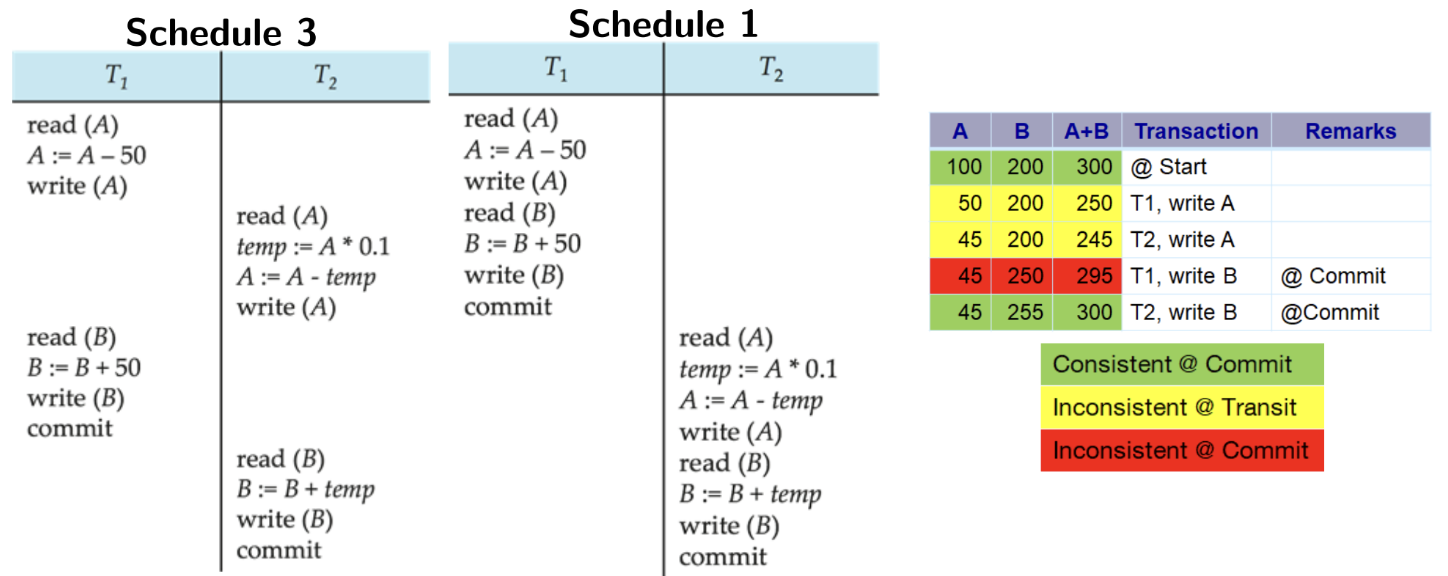
Serializability
A concurrent schedule is considered Serializable if its final outcome is identical to that of some purely serial schedule. If we can prove a schedule is serializable, we guarantee it preserves database consistency!
There are two primary ways to determine this: Conflict Serializability and View Serializability.
1. Conflict Serializability
To understand conflict serializability, we first need to define what a “conflict” is.
If a concurrent schedule can be transformed into a serial schedule by swapping non-conflicting adjacent instructions, we say the schedule is Conflict Serializable.
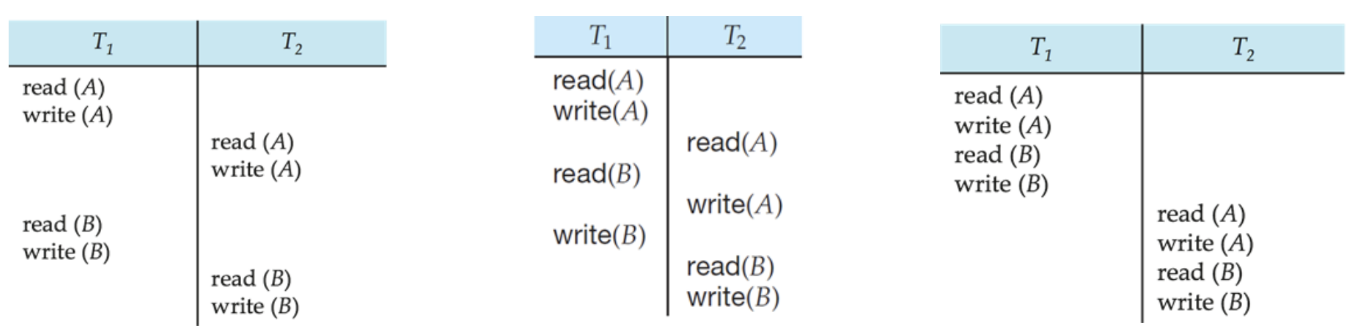
The Precedence Graph
Checking every possible swap is tedious. Instead, we use a Precedence Graph:
Draw a node for each transaction.
Draw a directed edge from \(T_i\) to \(T_j\) if they have conflicting instructions and \(T_i\) executed first.
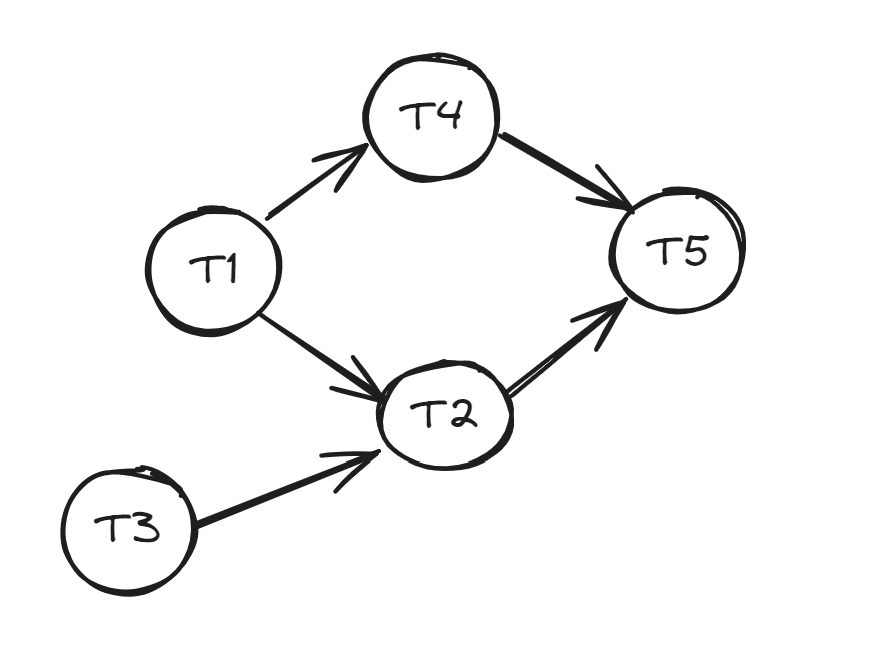
(Note: If the graph is acyclic, you can use topological sorting to find the exact serial execution order).
2. View Serializability
View serializability is a slightly looser definition than conflict serializability. Two schedules are “view equivalent” if they meet three conditions for every data item:
Initial Read: If \(T_i\) reads the initial value of \(Q\) in the first schedule, it must do so in the second.
Write-Read Pair: If \(T_j\) reads a value of \(Q\) written by \(T_i\) in the first schedule, it must read the value written by that exact same \(T_i\) in the second.
Final Write: The transaction that performs the last write to \(Q\) must be the same in both schedules.
Every conflict-serializable schedule is view-serializable. However, some view-serializable schedules are not conflict-serializable. This usually happens when there are Blind Writes (writing to a variable without ever reading it first).
Recovery and Cascading
If a transaction fails halfway through, we must roll it back to maintain the ACID property of Atomicity. This rollback process is known as Recovery. However, rolling back one transaction can cause a domino effect.
Recoverable Schedules
If Transaction B reads data written by Transaction A, then A must commit before B commits.
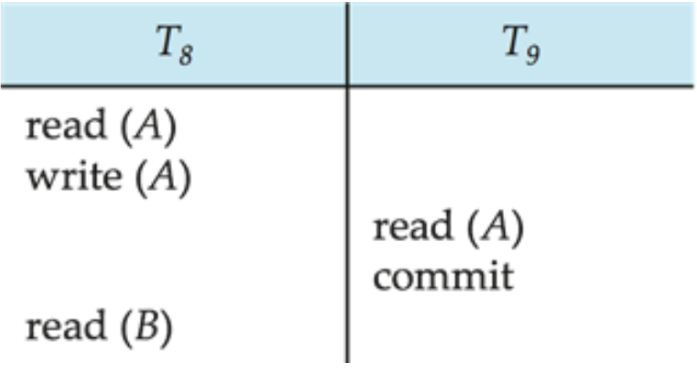
Cascading Rollbacks
Even if a schedule is recoverable, we can run into Cascading Rollbacks. If one transaction fails, every other transaction that read its dirty data must also be rolled back. This wastes a massive amount of computational work.
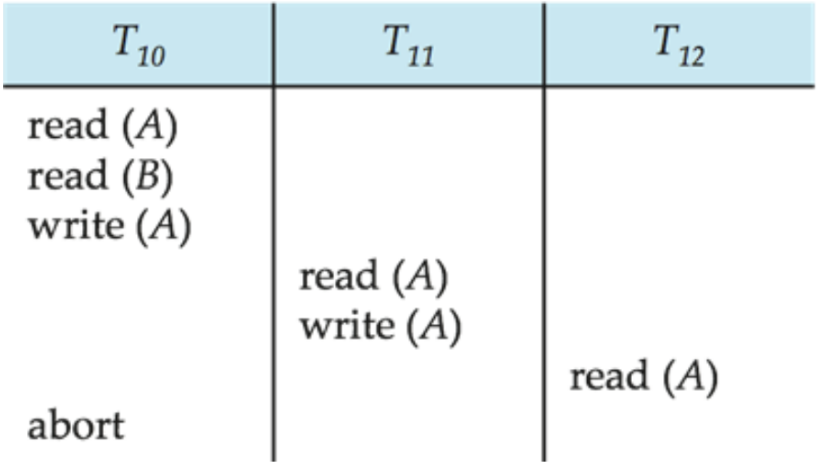
Cascadeless Schedules
To prevent cascading rollbacks, databases enforce Cascadeless Schedules. Rule: Transaction B cannot even read data written by Transaction A until Transaction A has fully committed. (Note: Every cascadeless schedule is inherently recoverable).
TCL (Transaction Control Language)
How do we actually manage these transactions in SQL? We use TCL commands!
COMMIT- Saves all changes permanently. The transaction is successfully concluded.ROLLBACK- Undoes all changes made during the current transaction.SAVEPOINT- Creates a bookmark within a transaction. You can choose to rollback to a specific savepoint instead of rolling back the entire transaction.SET TRANSACTION- Can be used to set properties, like making the transaction Read-Only.