Concurrency and Locking
The Need for Concurrency Control
We know that a schedule must be both conflict serializable and recoverable (preferably cascadeless). However, allowing transactions to just run wildly and hoping the schedule turns out serializable is a terrible strategy.
The database needs a Concurrency Control mechanism to enforce these rules dynamically as transactions arrive.
There is always a trade-off: The more strict the concurrency control scheme, the safer the data is, but the slower the database runs (because transactions have to wait in line).
Lock-Based Protocols
The most common way to control concurrency is by using Locks. Think of a lock like a bathroom key. If someone has the key, nobody else can enter until they give it back.
Data items can be locked in two modes:
Exclusive (X) mode: The data item can be both read AND written.
Shared (S) mode: The data item can ONLY be read.
The Lock-Compatibility Matrix
Before a transaction can lock an item, it must request it from the lock manager. The lock manager checks the compatibility matrix:
| State of the lock | Request: Shared | Request: Exclusive |
|---|---|---|
| Shared | Yes | No |
| Exclusive | No | No |
- Sharing is caring: Any number of transactions can hold Shared locks on the same item at the same time (since reading doesn’t change the data).
- Exclusivity: If any transaction holds an Exclusive lock, no other transaction can hold any lock on that item. They must wait.
A transaction must hold a lock on a data item for as long as it is actively accessing it. Once it’s done, it releases it using the unlock(Q) instruction.
The Two-Phase Locking Protocol (2PL)
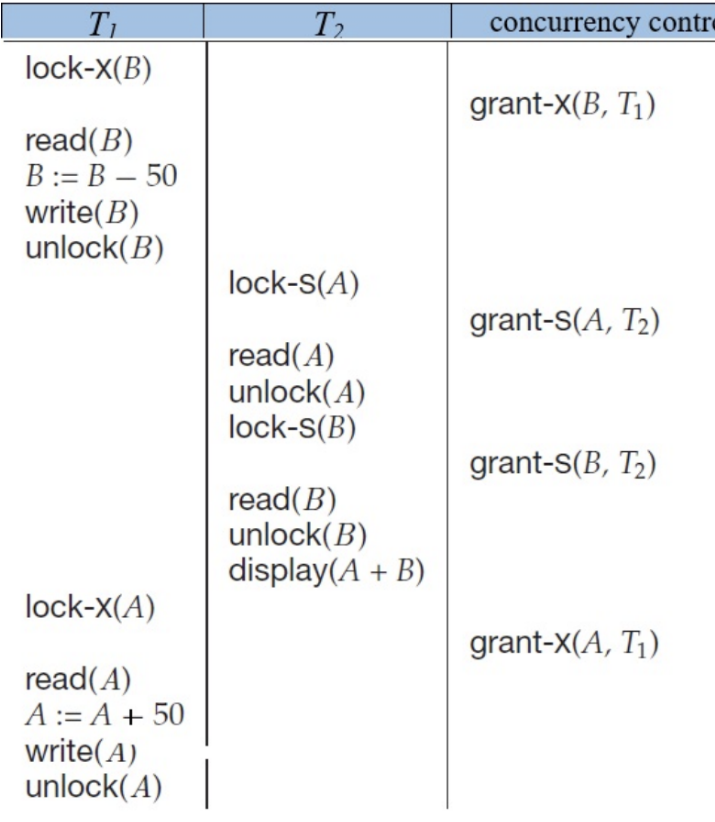
Just having locks isn’t enough to guarantee serializability. If a transaction locks an item, modifies it, unlocks it, and then locks another item, we can still run into consistency issues.
To solve this, databases use the Two-Phase Locking (2PL) protocol. Under 2PL, every transaction goes through two distinct phases:
- Growing Phase:
- A transaction may obtain new locks.
- It may not release any locks.
- Shrinking Phase:
- A transaction may release locks.
- It may not obtain any new locks.
Once a transaction releases its very first lock, it has entered the Shrinking Phase and can never request another lock again.
Lock Conversions
During these phases, 2PL allows locks to be converted:
Growing Phase: You can upgrade a Shared lock to an Exclusive lock.
Shrinking Phase: You can downgrade an Exclusive lock to a Shared lock.
Stricter Variants of 2PL
Standard 2PL guarantees serializability, but it does NOT guarantee cascadeless schedules. If a transaction fails during its Shrinking Phase after releasing some locks, other transactions might have already read its dirty data!
To prevent cascading rollbacks, databases use stricter versions of 2PL:
Strict Two-Phase Locking
- Standard 2PL rules apply.
- Addition: A transaction must hold all of its Exclusive locks until it fully commits or aborts.
- Why? This guarantees that no other transaction can read its uncommitted changes.
Rigorous Two-Phase Locking
- Standard 2PL rules apply.
- Addition: A transaction must hold ALL of its locks (both Shared and Exclusive) until it commits or aborts.
- Why? It is even safer and easier to implement, and transactions can be serialized in the exact order they commit.