BCNF and Multivalued Dependencies
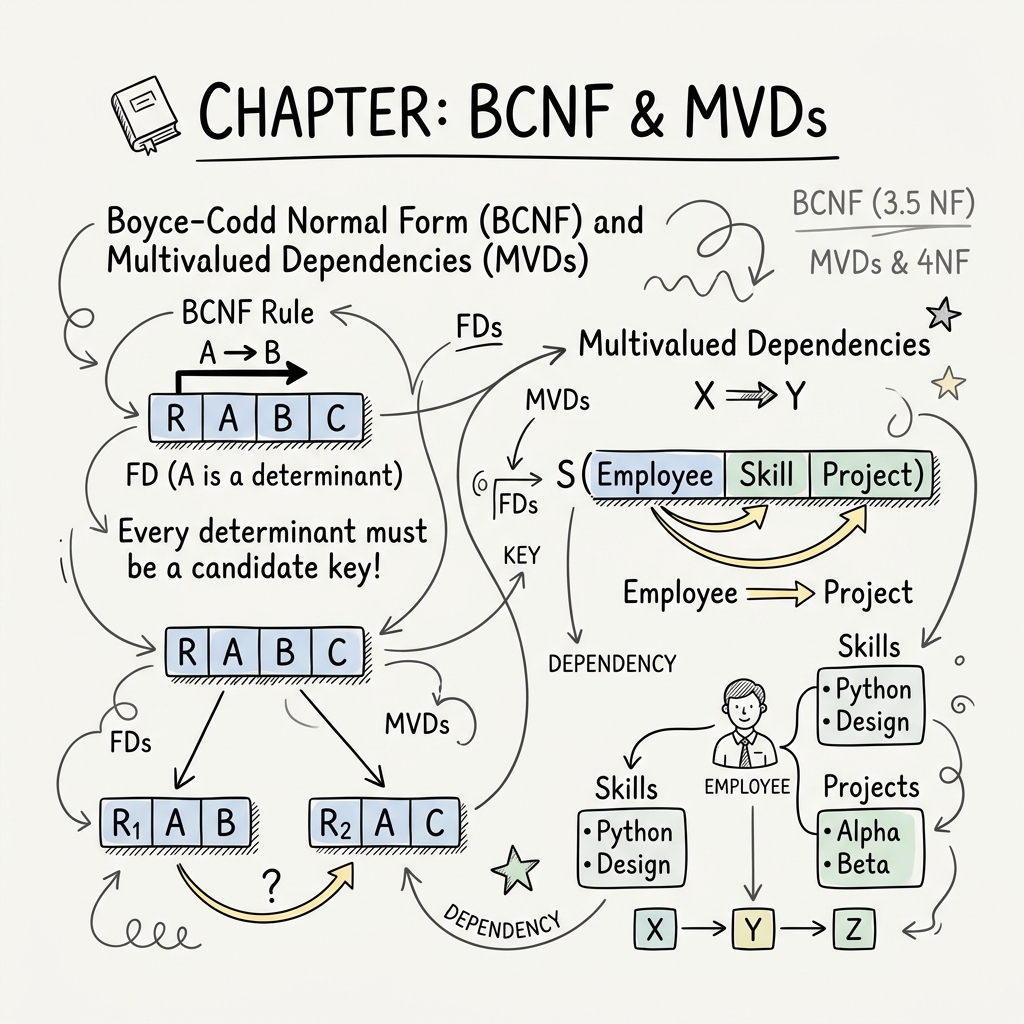
While 3NF is sufficient for most practical database designs, it still allows certain types of anomalies if there are overlapping candidate keys. Boyce-Codd Normal Form (BCNF) was introduced to handle these edge cases by applying a stricter rule.
BCNF (Boyce-Codd Normal Form)
A relational schema \(R\) is in BCNF if for every non-trivial functional dependency \(A \rightarrow B\) associated with \(R\), the following condition holds: - \(A\) must be a superkey.
Simply put: The left side of every functional dependency must uniquely identify the entire row. The “prime attribute” loophole present in 3NF is removed.
Note:
- BCNF decomposition is always lossless.
- BCNF decomposition may or may not be dependency preserving.
BCNF Solved Example 1: Success
Consider \(R(A, B, C, D)\) and its \(FD=\{A \rightarrow B, \space B \rightarrow C, \space C \rightarrow D, \space D \rightarrow A\}\)
Step 1: Find Candidate Keys
- \(A^+ = \{A, B, C, D\}\)
- \(B^+ = \{B, C, D, A\}\)
- \(C^+ = \{C, D, A, B\}\)
- \(D^+ = \{D, A, B, C\}\) Every single attribute is a candidate key (and thus, a superkey).
Step 2: Check BCNF Condition
- For \(A \rightarrow B\), \(A\) is a superkey.
- For \(B \rightarrow C\), \(B\) is a superkey.
- For \(C \rightarrow D\), \(C\) is a superkey.
- For \(D \rightarrow A\), \(D\) is a superkey.
Conclusion: All functional dependencies satisfy the BCNF condition. The relation is in BCNF.
BCNF Solved Example 2: Failure
Let’s look back at the example from the 3NF chapter: \(R(A, B, C, D, E, F)\) with \(FD=\{AB \rightarrow CDE, \space E \rightarrow F, \space BF \rightarrow A, \space C \rightarrow B\}\). We found the candidate keys were \(\{A, B\}, \{A, C\}, \{B, F\}\).
Now let’s check the FDs against the strict BCNF rule:
- \(E \rightarrow F\): Is \(E\) a superkey? No.
- \(C \rightarrow B\): Is \(C\) a superkey? No.
Conclusion: Because \(E\) and \(C\) are not superkeys, the relation fails BCNF, even though it was successfully in 3NF!
Multivalued Dependency (MVD)
As we move beyond BCNF, we encounter anomalies caused by independent multivalued facts about an entity. This introduces the concept of Multivalued Dependency, denoted as \(\twoheadrightarrow\).
Let \(R\) be a relation schema. The multivalued dependency \(X \twoheadrightarrow Y\) holds if, for a single value of \(X\), there is a set of values for \(Y\) that are completely independent of the other attributes in the table.
For an MVD to exist:
- The total number of attributes in the table should be more than two.
- If there are exactly 3 attributes (\(X, Y, Z\)), then \(Y\) and \(Z\) must be independent of each other, but both depend on \(X\).
Visualizing MVD

In this example, an instructor teaches a course, and a course has recommended books.
- The instructors for a course are completely independent of the books for a course.
- Thus,
course_name\(\twoheadrightarrow\)instructor - And
course_name\(\twoheadrightarrow\){book, edition}
If you try to store this in a single table, you must repeat every instructor for every book, causing massive data redundancy!
Trivial MVD
An MVD \(X \twoheadrightarrow Y\) is considered trivial if:
- \(Y\) is a subset of \(X\) (\(Y \subseteq X\))
- Or, \(X \cup Y = R\) (the entire table)
MVD Theory Rules
MVDs follow a set of inference rules, similar to regular functional dependencies:
| Name | Rule |
|---|---|
| Complementation | If \(X \twoheadrightarrow Y\), then \(X \twoheadrightarrow (R − (X \cup Y))\) |
| Augmentation | If \(X \twoheadrightarrow Y\) and \(W \supseteq Z\), then \(WX \twoheadrightarrow YZ\) |
| Transitivity | If \(X \twoheadrightarrow Y\) and \(Y \twoheadrightarrow Z\), then \(X \twoheadrightarrow (Z−Y)\) |
| Replication | If \(X \rightarrow Y\), then \(X \twoheadrightarrow Y\) (but the reverse is not true) |
| Coalescence | If \(X \twoheadrightarrow Y\) and there is a \(W\) such that \(W \cap Y\) is empty, \(W \rightarrow Z\), and \(Z \subseteq Y\), then \(X \rightarrow Z\) |
4NF (Fourth Normal Form)
To resolve the redundancies caused by Multivalued Dependencies, we use the Fourth Normal Form.
A relation schema \(R\) is in 4NF if and only if the following conditions are satisfied:
- \(R\) is already in BCNF.
- It does not contain any non-trivial multi-valued dependencies.
If a table violates 4NF due to \(X \twoheadrightarrow Y\), we fix it by decomposing the table into two separate tables: one holding \((X, Y)\) and the other holding \((X, \text{everything else})\).