Normal Forms (1NF to 3NF)
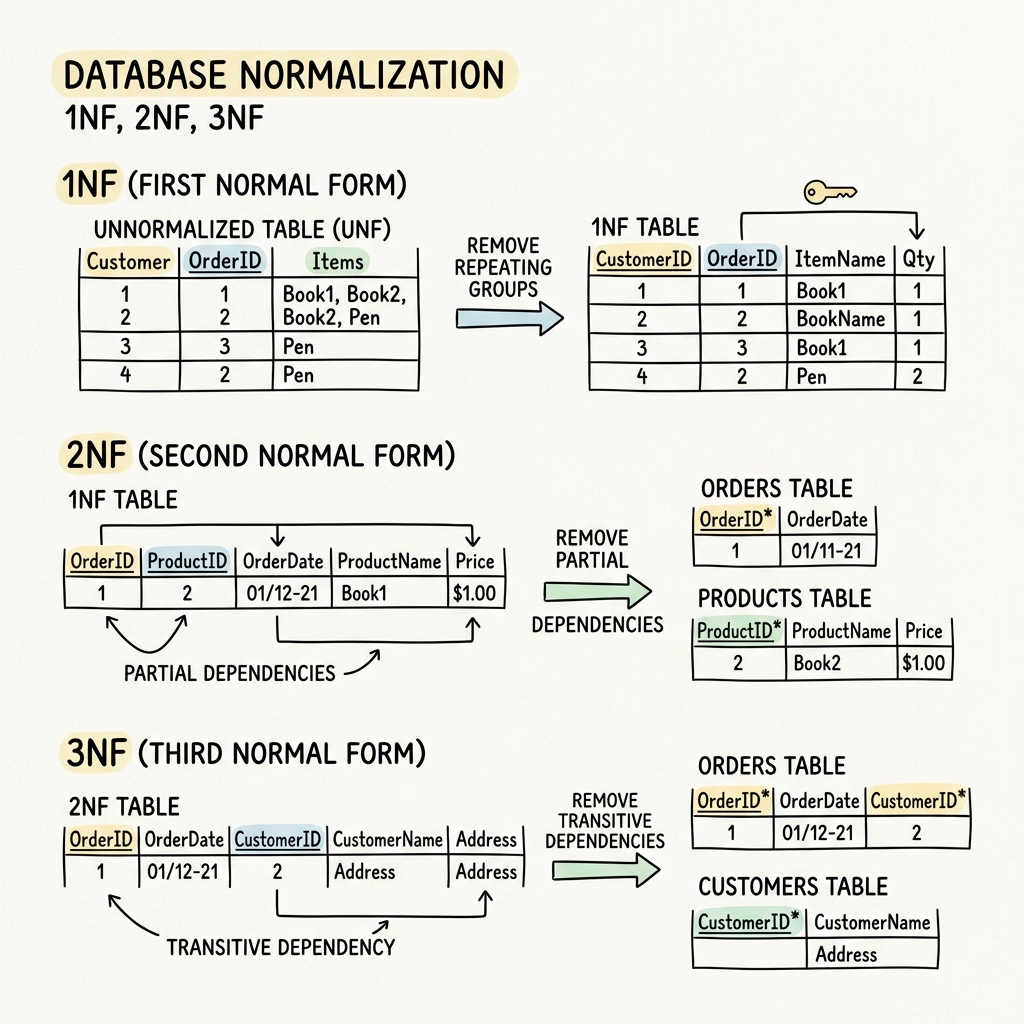
A Normal Form specifies a set of conditions that a relational schema must satisfy in terms of its constraints. As we move from 1NF up to higher normal forms, the rules become stricter, and data redundancy is further reduced.
1NF (First Normal Form)
A relation is in First Normal Form (1NF) if and only if it satisfies the following rules:
Atomic Values: All domains should only have atomic (indivisible) values.
No Multivalued Attributes: Each cell of the table must hold a single value.
Example: Failing 1NF
Consider a table storing student courses:
| SID | Sname | Cname |
|---|---|---|
| S1 | A | C, C++ |
| S2 | B | C++, DB |
| S3 | C | DB |
- The
Cnamecolumn contains multiple values for S1 (“C”, “C++”) and S2 (“C++”, “DB”). - Because Cname is a multivalued attribute, the above table is not in 1NF.
- To convert this to 1NF, we would create separate rows for each course a student takes.
2NF (Second Normal Form)
A relation \(R\) is in Second Normal Form (2NF) only if:
It is already in 1NF.
It contains no Partial Dependency.
Understanding Partial Dependency
A dependency \(A \rightarrow B\) is a partial dependency only if:
\(A\) is a proper subset of a Candidate Key.
\(B\) is a Non-Prime Attribute (an attribute not part of any candidate key).
In simple terms: No non-prime attribute should depend on just a part of a composite candidate key. If a table has a single-attribute candidate key (and it’s the only key), it is automatically in 2NF.
2NF Solved Example
Consider a relation \(R(A, B, C, D, E, F)\) and its Functional Dependencies: \[FD=\{AB \rightarrow CDE, \space E \rightarrow F, \space BF \rightarrow A, \space C \rightarrow B\}\]
Step 1: Find the Candidate Keys Let’s find the closures of attribute sets to see which ones determine all attributes in \(R\).
\((AB)^+ = \{A, B, C, D, E, F\}\)
Since \(C \rightarrow B\), we can substitute \(B\) with \(C\): \((AC)^+ = \{A, C, B, D, E, F\}\)
Since \(BF \rightarrow A\), if we have \(B\) and \(F\), we get \(A\). Thus \((BF)^+ = \{B, F, A, C, D, E\}\)
Our Candidate Keys are: \(\{A, B\}, \{A, C\}, \{B, F\}\).
Step 2: Identify Prime and Non-Prime Attributes
Prime Attributes: \(A, B, C, F\) (since they appear in at least one candidate key).
Non-Prime Attributes: \(D, E\).
Step 3: Check for Partial Dependencies We need to check if any non-prime attribute (\(D\) or \(E\)) depends on a proper subset of a candidate key. The proper subsets of our candidate keys are \(\{A\}, \{B\}, \{C\}, \{F\}\).
Do we have \(A \rightarrow D\) or \(A \rightarrow E\)? No.
Do we have \(B \rightarrow D\) or \(B \rightarrow E\)? No.
Do we have \(C \rightarrow D\) or \(C \rightarrow E\)? No (\(C\) only determines \(B\), which is a prime attribute).
Do we have \(F \rightarrow D\) or \(F \rightarrow E\)? No.
Since no non-prime attribute depends on a part of a candidate key, there is no partial dependency. Conclusion: Relation \(R\) is in 2NF.
3NF (Third Normal Form)
A relational schema \(R\) is in 3NF if, for every functional dependency \(A \rightarrow B\) associated with \(R\), at least one of the following conditions is true:
\(B \subseteq A\) (It is a trivial FD).
\(A\) is a superkey of \(R\).
\(B\) is a prime attribute of \(R\).
In simple terms: 3NF prohibits transitive dependencies where a non-prime attribute determines another non-prime attribute.
Note:
- 3NF guarantees both dependency preservation and lossless join decomposition.
3NF Solved Example
Let’s use the same relation \(R(A, B, C, D, E, F)\) with \(FD=\{AB \rightarrow CDE, \space E \rightarrow F, \space BF \rightarrow A, \space C \rightarrow B\}\). We know it is in 2NF. We know the Candidate Keys are \(\{A, B\}, \{A, C\}, \{B, F\}\), and Prime Attributes are \(A, B, C, F\).
Let’s check each FD against the 3NF rules:
\(AB \rightarrow CDE\): \(AB\) is a superkey. (Condition 2 holds - Passes).
\(E \rightarrow F\): \(E\) is not a superkey. However, \(F\) is a prime attribute! (Condition 3 holds - Passes).
\(BF \rightarrow A\): \(BF\) is a superkey. (Condition 2 holds - Passes).
\(C \rightarrow B\): \(C\) is not a superkey. However, \(B\) is a prime attribute! (Condition 3 holds - Passes).
Conclusion: Since every functional dependency satisfies at least one of the 3NF conditions, the relation \(R\) is in 3NF.