RAID: Redundant Array of Independent Disks
What is RAID?
A single disk has two problems: it’s slow, and it can fail. RAID solves both by combining multiple disks into what looks like one — spreading data across them for speed and duplicating it for safety. RAID (Redundant Array of Independent Disks) is a disk organization technique that manages multiple disks and presents them as a single logical disk. It achieves two things simultaneously:
- Speed — by using multiple disks in parallel, it delivers high capacity and high throughput.
- Reliability — by storing data redundantly across disks, it ensures data can be recovered even if one disk fails.
Three Core Techniques
Mirroring
Every disk has an exact duplicate — the logical disk consists of two physical disks.
- Every write is carried out on both disks simultaneously.
- Reads can be served from either disk.
- If one disk in a pair fails, data is still available on the other.
- Data loss only occurs if both disks in a pair fail before one is repaired — extremely unlikely.
Striping
Data is split across multiple disks so reads and writes happen in parallel.
Bit-level Striping
- Bits of each byte are split across multiple disks (bit \(i\) goes to disk \(i\)).
- Each access reads data at up to 8× the rate of a single disk.
- Seek and access time is worse than a single disk — rarely used today.
Byte-level Striping
- Each file is split into 1-byte chunks distributed across disks.
- The \(i\)th byte goes to disk \(((i-1) \mod n) + 1\).
Block-level Striping
- Block \(i\) of a file goes to disk \((i \mod n) + 1\).
- Requests for different blocks can run in parallel if they reside on different disks.
- A long sequential read can utilise all disks at once.
Parity
Parity provides fault tolerance by storing extra computed information alongside the data. If a disk fails, the lost data can be reconstructed from the remaining disks and the parity — without needing a full duplicate copy.
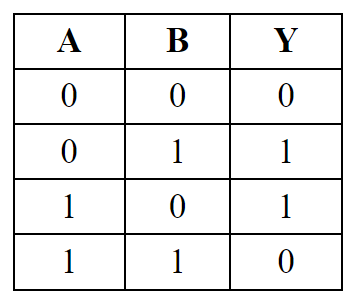
Parity is computed using XOR: for any set of bits, XOR of all bits including the parity bit equals zero. So if one disk’s bits are lost, XOR of the remaining disks recovers them.
Bit-interleaved Parity
- One parity bit covers the corresponding bits across all data disks.
- Written to a dedicated parity disk on every write.
- On disk failure: XOR all remaining bits (including parity) to reconstruct the lost bit.
Block-interleaved Parity
- Uses block-level striping with a dedicated parity block (not just a bit) for every set of corresponding blocks across \(n\) disks.
- On disk failure: XOR the corresponding blocks from all remaining disks to reconstruct the lost block.
Standard RAID Levels
RAID 0 — Block Striping
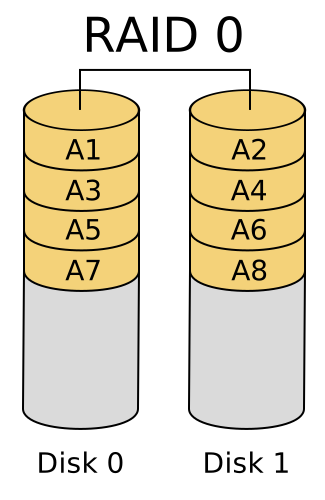
- Data is striped across disks with no redundancy whatsoever.
- Best write performance of all RAID levels — no parity to update.
- 100% storage efficiency.
- No fault tolerance — one disk failure loses everything.
RAID 1 — Mirroring
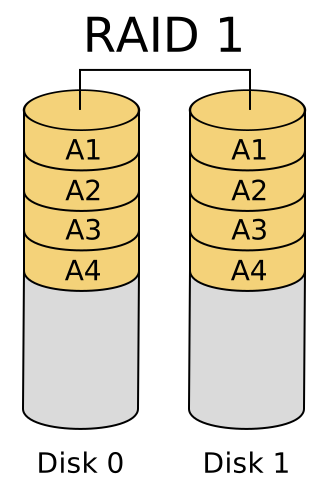
- Every disk has an exact copy on a second disk. Every write of a disk block involves a write on both disks.
- Excellent fault tolerance — survives one disk failure.
- Reads can be served from either disk in parallel.
- 50% storage efficiency — half your disks are copies.
- Most expensive solution.
RAID 2 — Parity
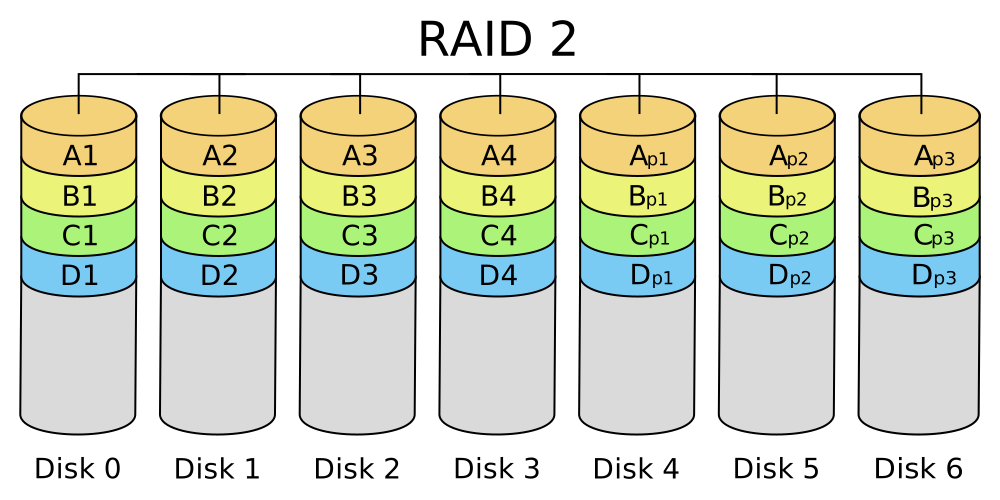
- Uses dedicated bit for parity and the striping is a single bit, uses Hamming codes for error correction.
- Can correct one-bit errors and detect two-bit errors.
- Requires multiple dedicated check disks.
- Not used in practice — subsumed by RAID 3.
RAID 3 — Byte Striping + Parity
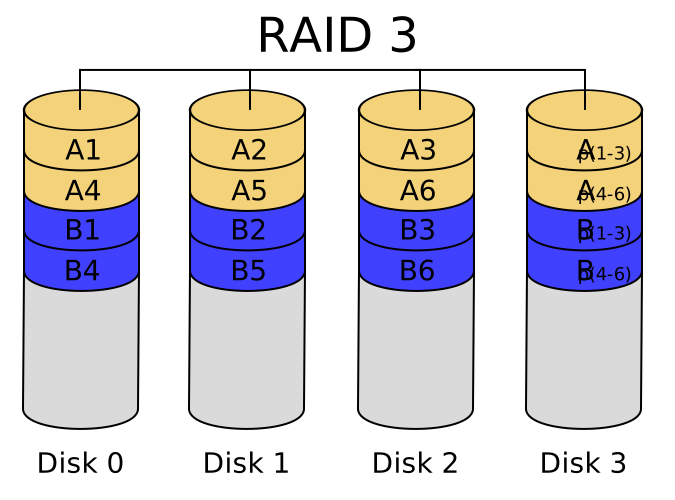
- Strips at the byte level with a single dedicated parity disk.
- High data transfer rate — data accessed in parallel across all disks.
- Cannot service multiple requests simultaneously — every request touches every disk.
- Reliability overhead for RAID 3 is a single disk, the lowest over-head possible.
RAID 4 — Block Striping + Parity
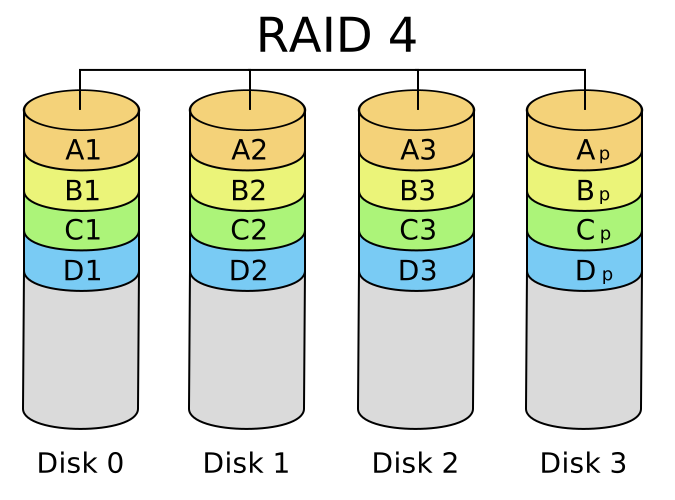
- Strips at the block level with a single dedicated parity disk.
- Read requests can be served by a single disk — better than RAID 3 for reads.
- Can recover from one disk failure using XOR.
- Write performance is poor — every write hits the single parity disk, creating a bottleneck.
RAID 5 — Distributed Parity
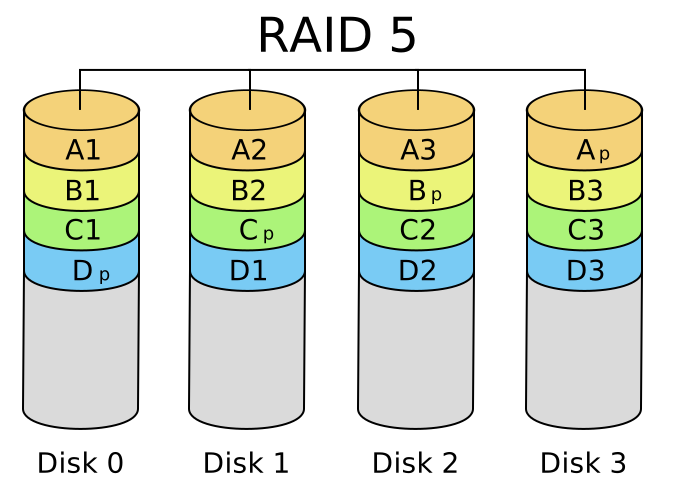
- Like RAID 4 but parity blocks are spread across all disks instead of sitting on one dedicated disk.
- Eliminates the parity bottleneck — multiple writes can happen in parallel.
- All disks participate in reads — higher read parallelism.
- Allows recovery of only 1 disk failure.
RAID 6 — Dual Parity
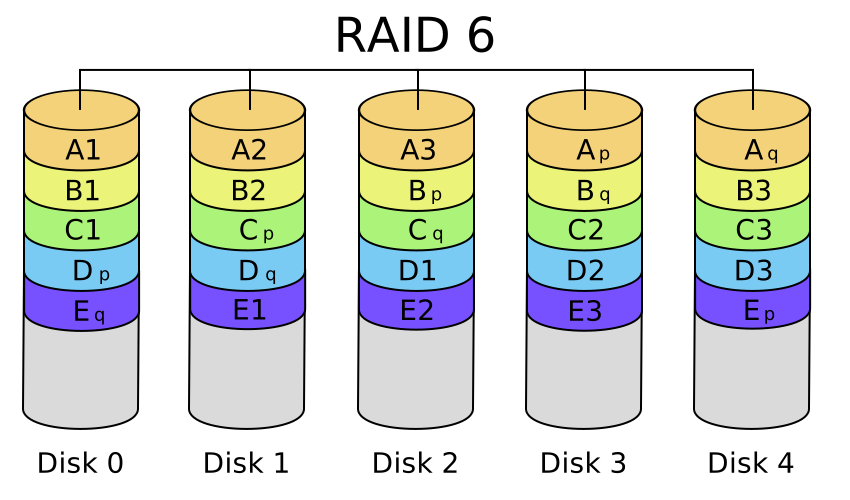
- Extends RAID 5 with a second parity block, using Reed-Solomon codes.
- Survives two simultaneous disk failures — safe even during a rebuild after one failure.
- Write performance worse than RAID 5 — two parity blocks to update.
RAID 01 — Mirror of Stripes
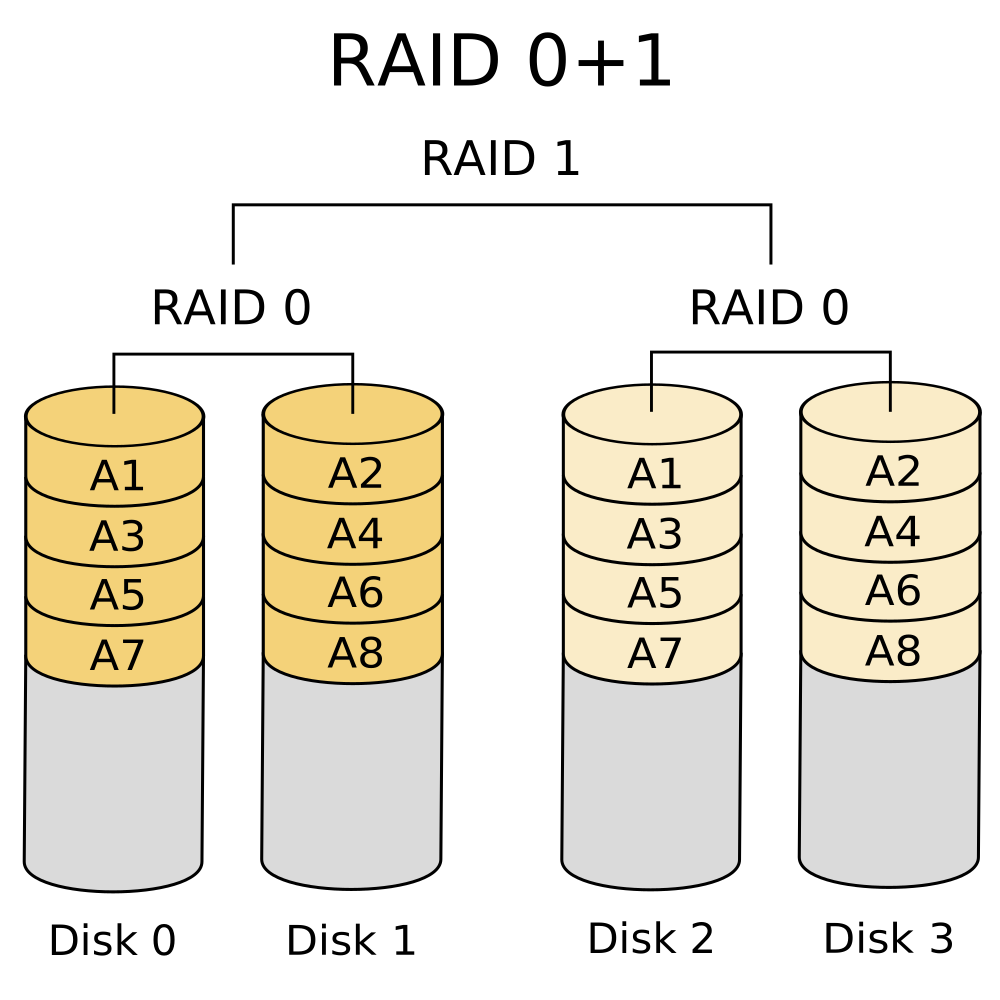
- Stripe sets are built first (RAID 0), then each set is mirrored (RAID 1).
- If one disk in a stripe fails, the entire stripe set is lost — falls back to the mirror.
- Less resilient than RAID 10.
- Requires at least 4 disks. Storage efficiency: 50%.
RAID 10 — Stripe of Mirrors
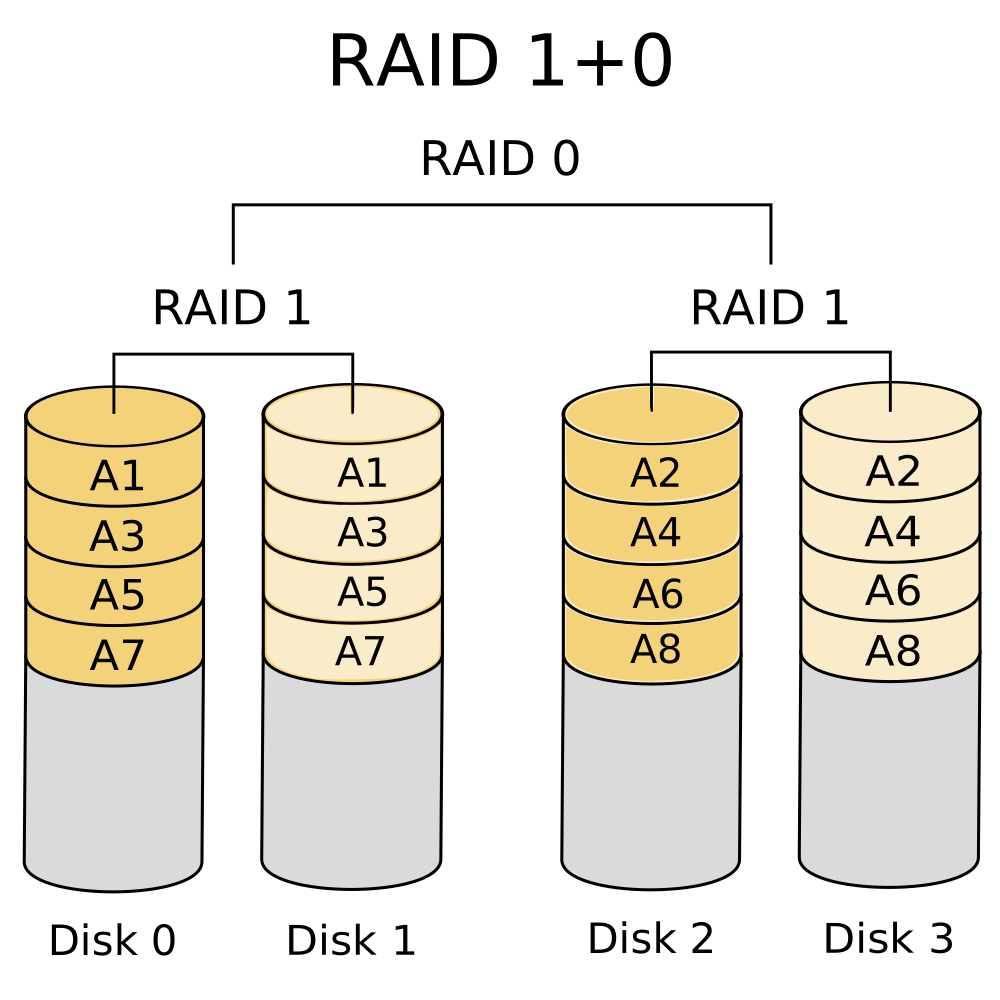
- Disks are mirrored first (RAID 1), then striped across the mirror pairs (RAID 0).
- One disk in each mirror pair can fail independently — far more resilient than RAID 01.
- Best throughput and latency of all fault-tolerant RAID levels.