Query Processing and Cost
Overview of Query Processing
When you submit a query to a database, it doesn’t just execute it directly. It goes through a series of logical steps to ensure the query is valid and to find the most efficient way to execute it.
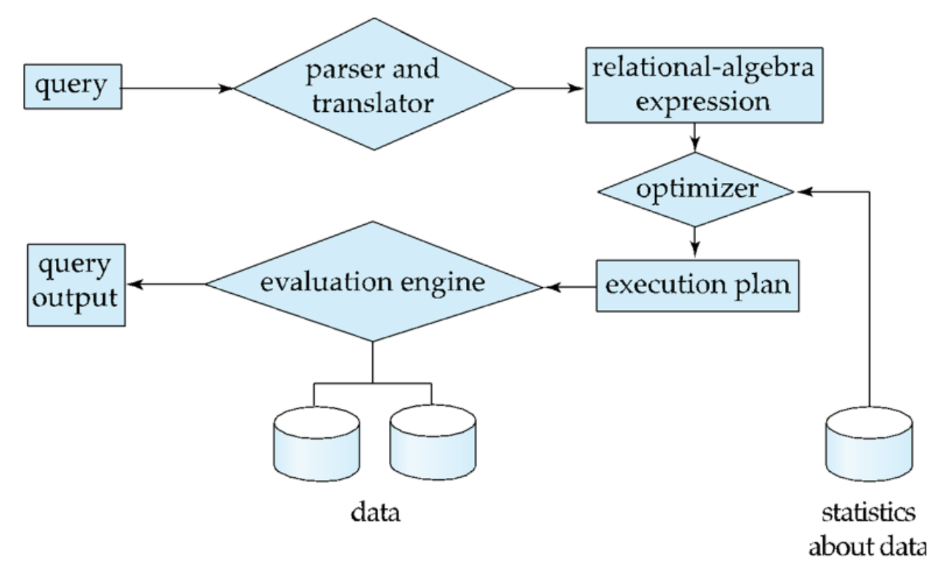
The process can be broken down into three main phases:
1. Parser and Translator
- What it does: The database receives the raw SQL query. It checks the syntax to ensure it’s valid SQL, and verifies that the referenced tables and columns exist in the database schema.
- Output: It translates the query into an internal format, typically a relational algebra expression.
2. Optimization
- What it does: This is the most crucial step for performance. A single SQL query can often be executed in multiple ways (e.g., different join orders, using an index vs. scanning a table).
- The Optimizer’s Job: It analyzes these different strategies (execution plans), estimates the cost of each using available database statistics, and selects the one with the lowest overall cost.
3. Evaluation
- What it does: The query-execution engine takes the optimized query-evaluation plan and actually runs it against the data.
- Output: It returns the final result set (the answers) to the user.
Measures of Query Cost
How does the optimizer determine the “cost” of a query plan?
The true cost is generally measured as the total elapsed time required to answer the query. This involves several factors:
Disk accesses (reading/writing data from/to storage)
CPU time (processing the data)
Network communication (if data is distributed)
However, because fetching data from disk is typically the slowest operation by a huge margin, we simplify the cost measure to focus primarily on disk I/O.
We measure cost using two main metrics:
Number of block transfers (\(b\)): The number of data blocks that must be read from or written to the disk.
Number of seeks (\(S\)): The number of times the disk head must move to a new location to read a block.
The Cost Formula
We can estimate the time cost with this simple formula:
\[ \text{Cost} = (b \times t_T) + (S \times t_S) \]
Where:
\(b\) = Total number of block transfers
\(t_T\) = Time to transfer one block
\(S\) = Total number of seeks
\(t_S\) = Time for one seek