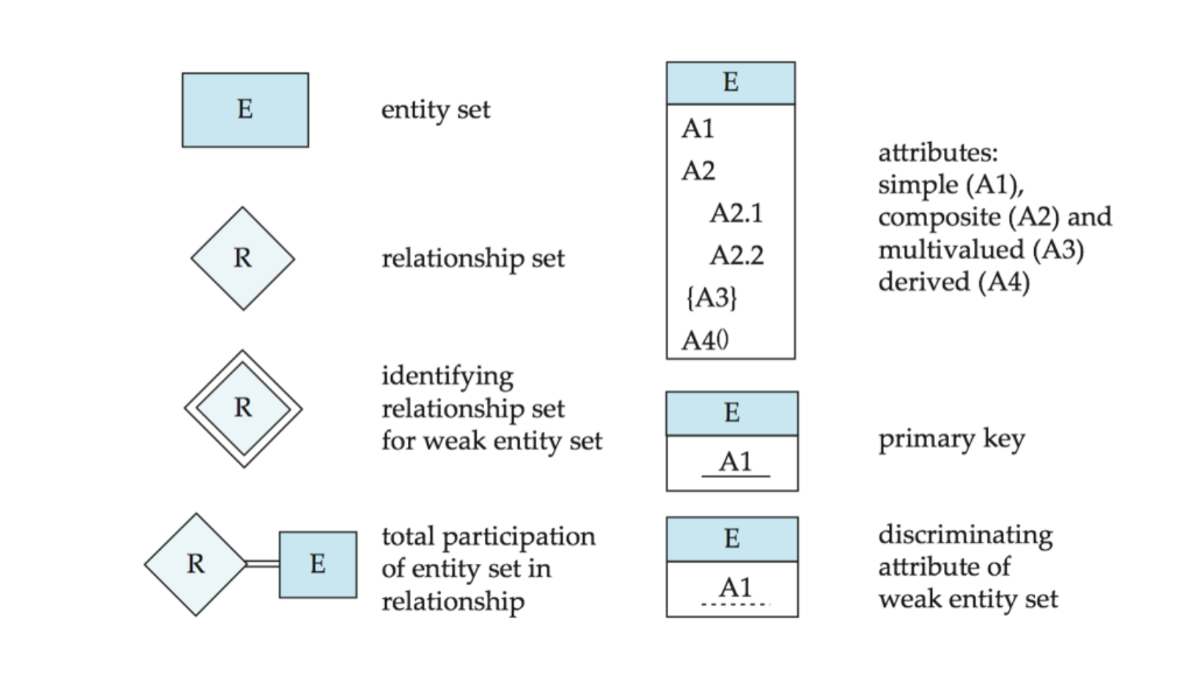
Advanced ER Concepts
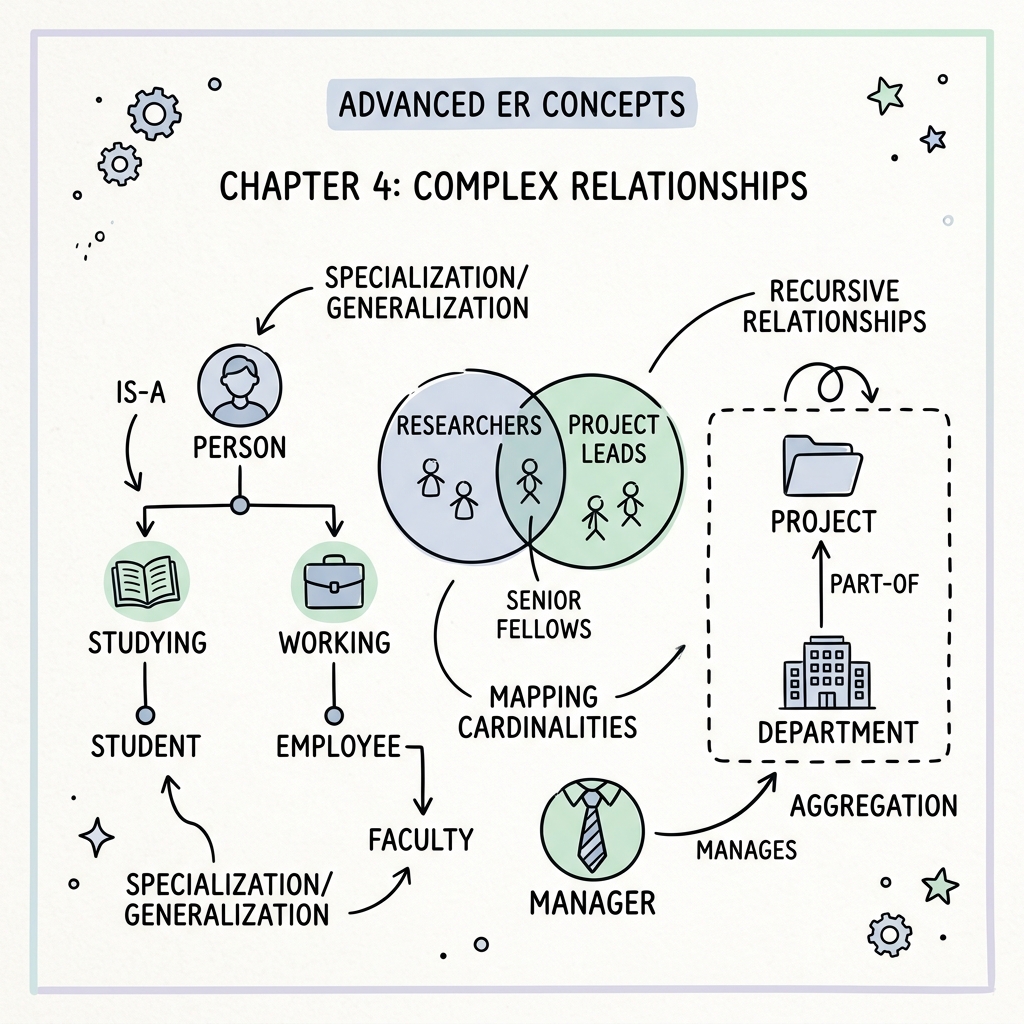
As databases grow in complexity, the standard Entity-Relationship model may not be sufficient to capture intricate real-world constraints and relationships. To address this, extended ER features are used.
Ternary Relationships
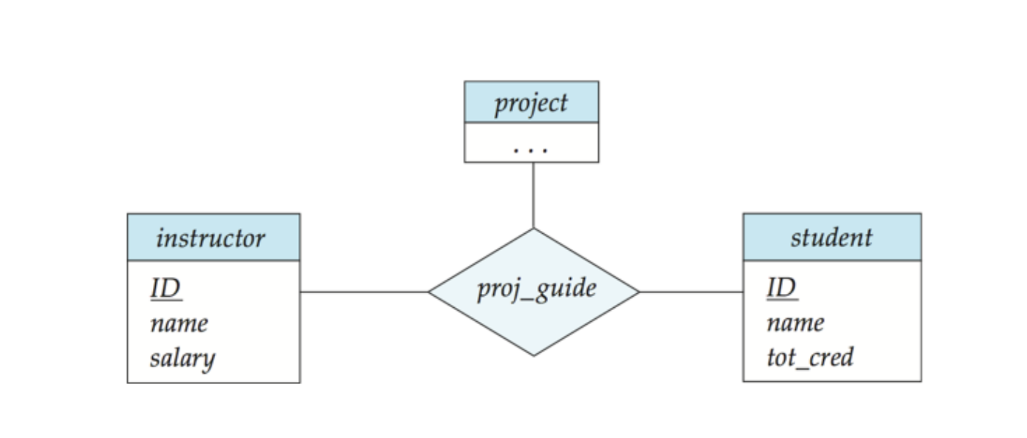
A Ternary Relationship is a relationship that exists among three entity sets simultaneously. Instead of linking two entity sets (binary), a single diamond connects three rectangles.
Example: Consider a scenario where Instructors assign Projects to Students. This cannot be accurately captured by breaking it into binary relationships because a specific student is assigned a specific project by a specific instructor. Thus, the relationship involves all three entities at once.
Aggregation
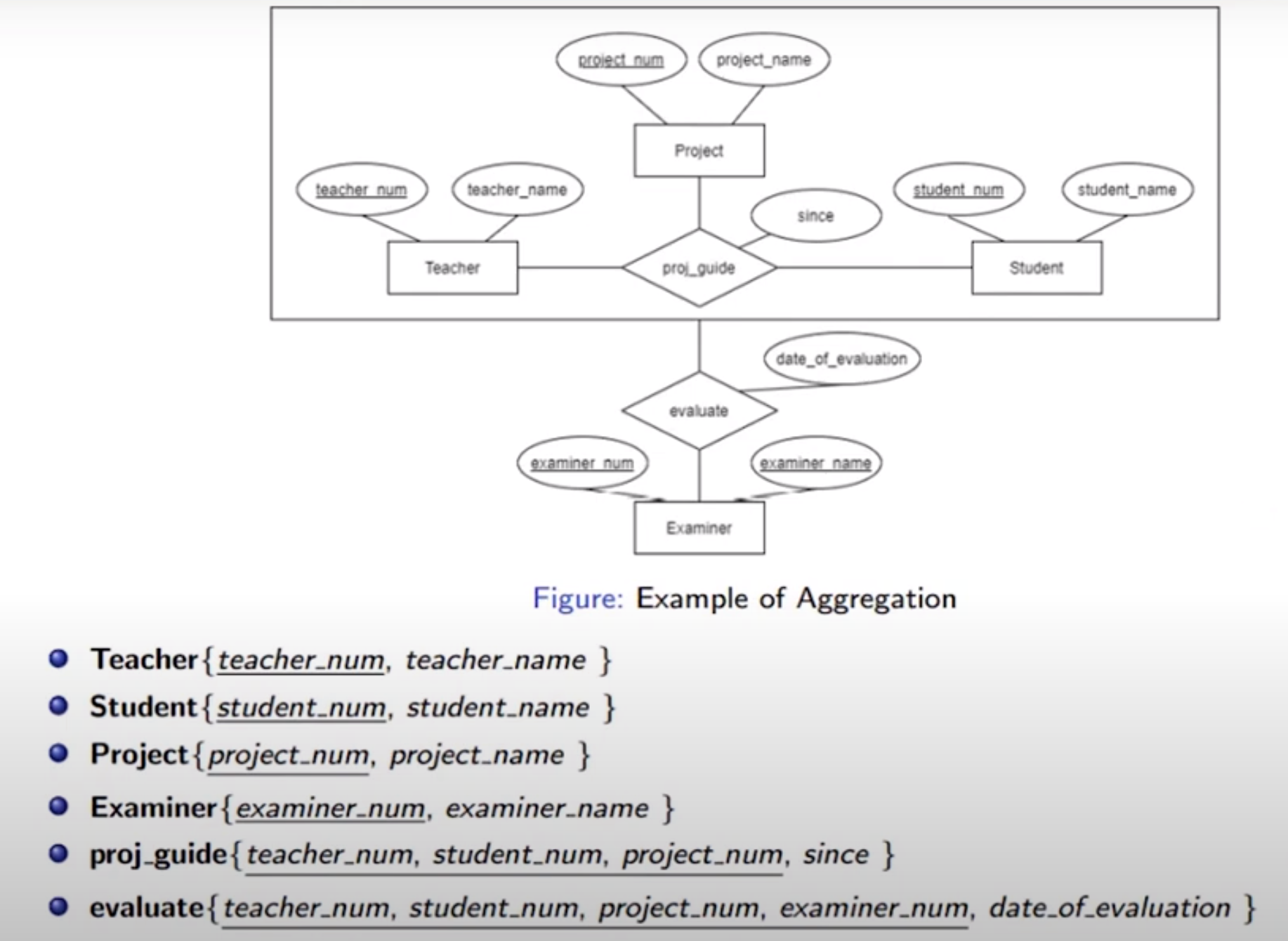
Aggregation is an abstraction through which relationships are treated as higher-level entities. We use aggregation when we need to establish a relationship with another relationship.
Why use Aggregation over Ternary Relationships? Sometimes, a ternary relationship doesn’t clearly convey the natural hierarchy of the data. If a relationship inherently acts like an entity that participates in another relationship, aggregation is a better design choice.
Example: Suppose an Instructor and a Student have an Advises relationship. Now, suppose a Project is assigned to that specific (Instructor, Student) pair. Instead of making a ternary relationship, we draw a box around the Advises relationship (aggregating it into a higher-level entity) and connect it to the Project entity via an Assigned relationship.
Extended ER Features: Specialization and Generalization
Specialization is the process of defining a set of subclasses from an entity set (top-down approach). Generalization is the reverse process of combining subclasses into a higher-level superclass (bottom-up approach).
When dealing with class hierarchies, we must define constraints on how entities can participate in the subclasses. These constraints are categorized by disjointness and completeness.
Disjointness Constraints
- Disjoint: An entity can belong to at most one lower-level entity set (subclass).
- Overlapping: An entity can belong to more than one lower-level entity set simultaneously.
Completeness Constraints
- Complete (Total): Every entity in the higher-level entity set (superclass) must belong to at least one lower-level entity set.
- Partial: Some entities in the higher-level entity set might not belong to any lower-level entity set.
| Specialization | Disjointness rule | Completeness rule | Example |
|---|---|---|---|
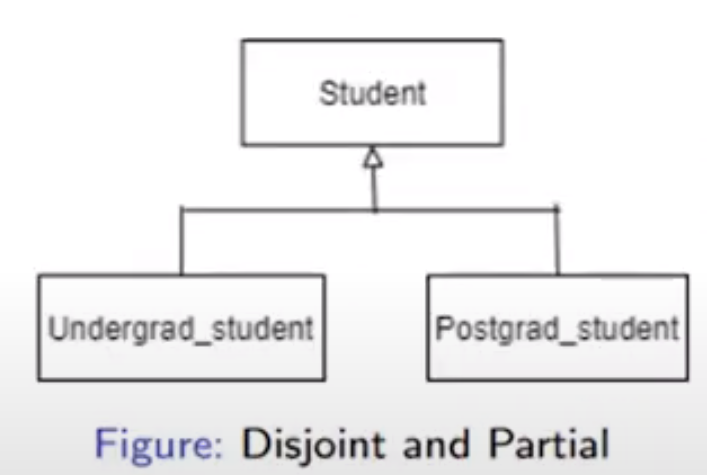
| Disjoint, partial | At most one subclass | May belong to no subclass | A student may be UG or PG, but visiting/diploma students may be neither. |
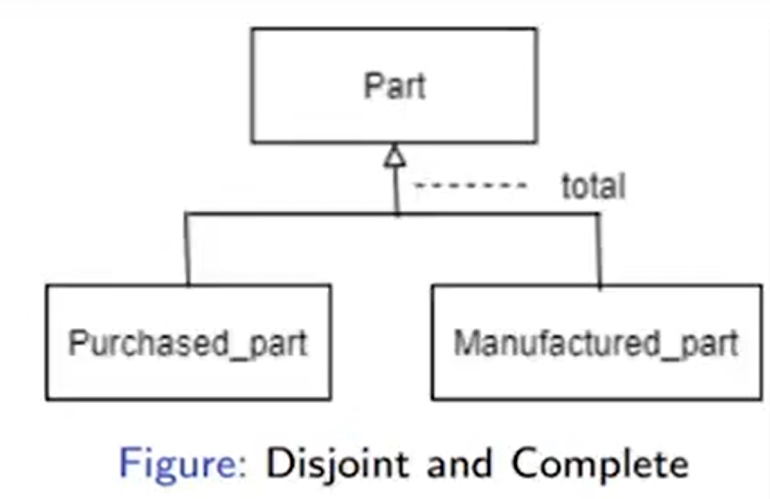
| Disjoint, complete | At most one subclass | Must belong to one subclass | Every part is either purchased or manufactured, never both. |
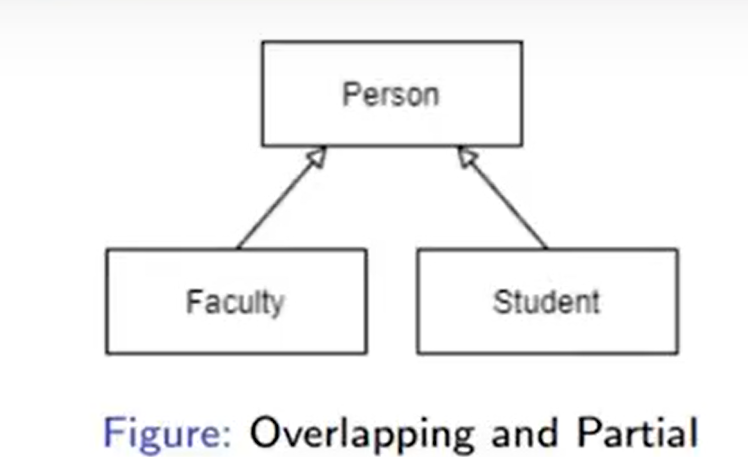
| Overlapping, partial | May belong to multiple subclasses | May belong to no subclass | A person may be a student, an instructor, both, or neither. |
1. Overlapping and Partial
- Overlapping: An entity can belong to multiple subclasses.
- Partial: An entity does not have to belong to any subclass.
Example: A Person can be a Student, a Faculty member, or both (Overlapping). Also, there may be persons (like staff or guests) who are neither students nor faculty (Partial).
2. Disjoint and Partial
- Disjoint: An entity can belong to at most one subclass.
- Partial: An entity does not have to belong to any subclass.
Example: A Student can be either an UG_Student (Undergraduate) or a PG_Student (Postgraduate), but they cannot be both at the same time (Disjoint). Furthermore, there might be some students (e.g., diploma or visiting students) who are neither UG nor PG students (Partial).
3. Disjoint and Complete
- Disjoint: An entity can belong to at most one subclass.
- Complete: Every entity must belong to a subclass.
Example: Every physical Part in a factory must be classified as either a Purchased_Part or a Manufactured_Part (Complete). A part cannot be both purchased and manufactured simultaneously (Disjoint).
(Note: The fourth combination, Overlapping and Complete, implies an entity must belong to at least one subclass and can belong to multiple. It is less common but conceptually possible.)
Summary
The concepts covered in the Entity-Relationship model can be summarized below.