Deadlocks and Timestamps
Understanding Deadlocks
Locking protocols solve the problem of inconsistency, but they introduce a new problem: Deadlock.
Imagine Transaction A holds a lock on item X and is waiting for a lock on item Y. Meanwhile, Transaction B holds a lock on item Y and is waiting for a lock on item X.
Neither transaction can ever proceed. They are stuck waiting for each other indefinitely.
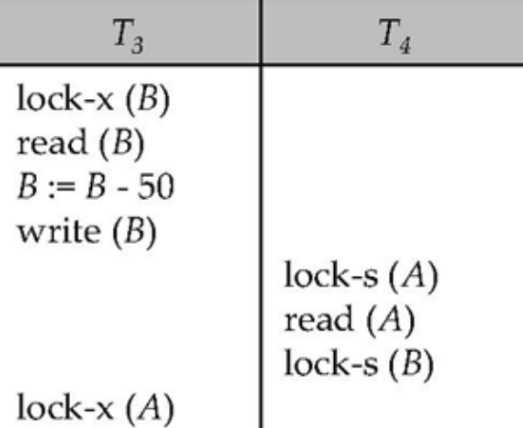
When a deadlock occurs, the system has no choice but to intervene. It must roll back (abort) one of the transactions to break the cycle and release its locks so the other can proceed.
Starvation
A related issue is Starvation. This occurs when a badly designed concurrency control manager repeatedly forces a transaction to wait forever, even without a deadlock. For example, if Transaction A wants an Exclusive lock, but a continuous stream of new transactions keep requesting and getting Shared locks on that item, Transaction A will starve. Alternatively, a transaction might be repeatedly chosen as the “victim” to be rolled back during deadlocks, never getting a chance to finish.
Deadlock Prevention
Rather than letting deadlocks happen and fixing them later, databases can use schemes to prevent them from ever occurring. These schemes often use Transaction Timestamps.
A Timestamp is a unique identifier assigned by the database that represents the exact moment a transaction started. An older transaction has a smaller timestamp, while a younger transaction has a larger timestamp.
1. The Wait-Die Scheme (Non-Preemptive)
Rule: Older transactions wait for younger ones. Younger transactions die.
If Transaction A requests a lock held by Transaction B:
If A is older than B \(\rightarrow\) A is allowed to wait.
If A is younger than B \(\rightarrow\) A is killed (dies) and rolled back.
2. The Wound-Wait Scheme (Preemptive)
Rule: Younger transactions wait for older ones. Older transactions wound (kill) younger ones.
If Transaction A requests a lock held by Transaction B:
If A is older than B \(\rightarrow\) A forces B to be killed (wounds it). B is rolled back and restarted later.
If A is younger than B \(\rightarrow\) A is allowed to wait.
Deadlock Detection
If a database doesn’t use prevention schemes, it must periodically check for deadlocks using a Wait-For Graph.
- Vertices (Nodes): Represent active transactions.
- Edges: A directed edge from \(T_i\) to \(T_j\) means that \(T_i\) is waiting for \(T_j\) to release a lock.
If a cycle is detected, the database selects a “victim” transaction and rolls it back.
Timestamp-Based Protocols
What if we didn’t use locks at all? Another way to handle concurrency is by strictly enforcing execution based on timestamps.
Every data item Q in the database maintains two timestamps:
W-timestamp(Q): The largest timestamp of any transaction that successfully wrote to Q.
R-timestamp(Q): The largest timestamp of any transaction that successfully read Q.
Read and Write Rules
Suppose Transaction \(T_i\) wants to read(Q):
If \(TS(T_i) < W\text{-timestamp}(Q)\): This means a younger transaction has already overwritten the data! \(T_i\) is trying to read the past. The read is rejected, and \(T_i\) is rolled back.
If \(TS(T_i) \ge W\text{-timestamp}(Q)\): The read is allowed! We update \(R\text{-timestamp}(Q)\) if \(T_i\)’s timestamp is larger.
Suppose Transaction \(T_i\) wants to write(Q):
If \(TS(T_i) < R\text{-timestamp}(Q)\): A younger transaction has already read the data assuming \(T_i\)’s write never happened. The write is rejected, and \(T_i\) is rolled back.
If \(TS(T_i) < W\text{-timestamp}(Q)\): A younger transaction has already overwritten the data. The write is rejected, and \(T_i\) is rolled back.
Otherwise, the write is allowed, and \(W\text{-timestamp}(Q)\) is updated.
Correctness and Drawbacks
- Pros: It guarantees serializability and inherently prevents deadlocks (because no transaction ever waits for a lock—they just execute or get rolled back).
- Cons: It does NOT guarantee cascadeless or recoverable schedules, so transaction failures can cause significant cascading rollbacks.