Algorithms & Data Structures
Algorithms and Complexity Analysis
Basics and Definitions
- Algorithm vs. Program: An algorithm is a finite sequence of well-defined, computer-implementable instructions to solve a class of problems or to perform a computation. Crucially, an algorithm must terminate. A program, such as an operating system, is an implementation that may run indefinitely without terminating.
Motivation for Analysis
Why do we analyze algorithms? - To predict performance (how fast will this run on a billion rows?). - To avoid bugs and provide guarantees on execution boundaries. - To understand the theoretical limits of computational problems.
Factors of Analysis
When we analyze an algorithm, we measure the “cost” based on several factors:
Time Complexity: How long does it take to execute?
Space/Storage Complexity: How much memory (RAM) does it consume?
Other factors: Power consumption and network bandwidth (especially relevant in cloud databases).
Methodologies
- Counting Model: A simplified theoretical model (Random-Access Machine) where we sum the cost and frequency of primitive operations (like addition, assignment, etc.).
- Asymptotic Analysis: We use Big-Oh (\(O\)) notation to measure the growth of resource requirements as the input size (\(n\)) increases toward infinity. We typically focus on the Worst case and Average case scenarios.
Complexity Classes
From fastest (best) to slowest (worst):
\(O(1)\) - Constant Time
\(O(\log n)\) - Logarithmic Time
\(O(n)\) - Linear Time
\(O(n \log n)\) - Linearithmic Time
\(O(n^2)\) - Quadratic Time
\(O(n^3)\) - Cubic Time
\(O(2^n)\) - Exponential Time
Data Structures
A Data Structure is a specialized format for organizing, processing, retrieving and storing data in memory. Standard operations on any data structure include: Create, Insert, Delete, Find (Search), Update, and Close.
Linear Data Structures
- Arrays: Contiguous blocks of memory.
- Advantage: Extremely fast indexed/random access (\(O(1)\)).
- Disadvantage: Very slow insertion/deletion (\(O(n)\)) because all subsequent elements must be shifted.
- Linked Lists: Elements are stored in nodes that contain pointers to the next node.
- Advantage: Very fast insertion/deletion (\(O(1)\) if you are already at the position).
- Disadvantage: Slow sequential access (\(O(n)\)) since you must traverse from the head.
- Queues: Follow First-In-First-Out (FIFO) logic (like a line at a grocery store).
- Stacks: Follow Last-In-First-Out (LIFO) logic (like a stack of plates).
Non-Linear Data Structures: Trees
Unlike arrays or linked lists, a tree is a hierarchical data structure. They are absolutely critical for database indexing.
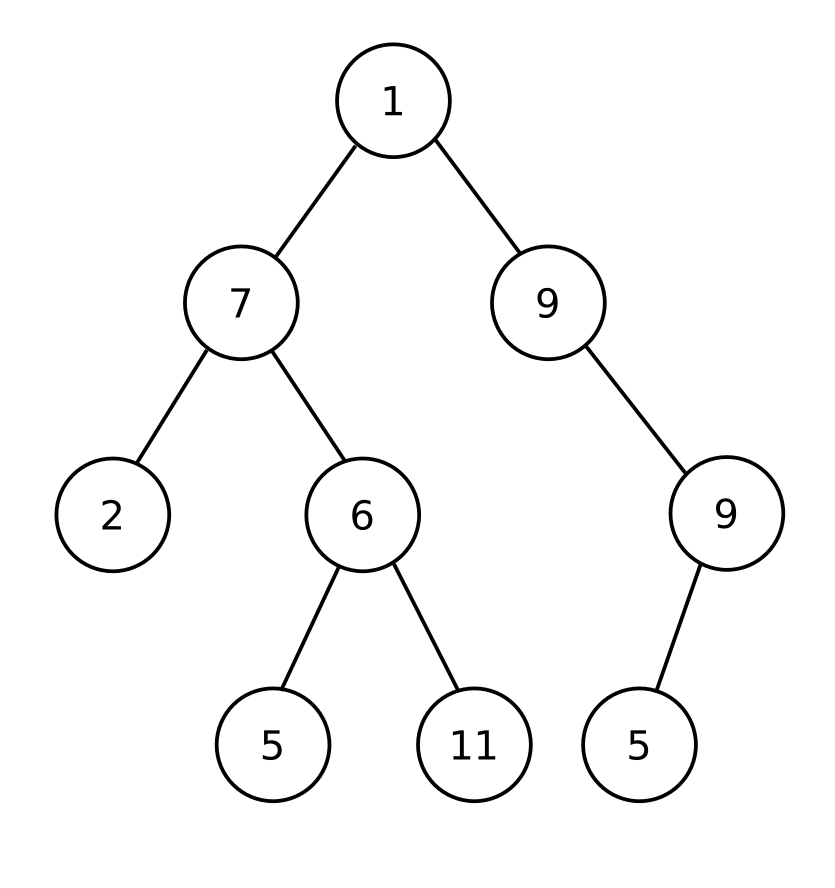
Let’s break down the terminology:
Root: The topmost node.
Parent/Child: A node connected to nodes directly below it is a parent.
Leaf Nodes: Nodes with no children.
Arity (or Degree): The number of children a specific node has.
Level / Depth: The distance from the root.
Height: The maximum level in the tree.
Binary Search Trees (BST)
A Binary Search Tree maintains a strict ordering property. For every node, all values in the left subtree are strictly less than the node’s value, and all values in the right subtree are greater.
Let’s build a BST from the data: 17, 22, 12, 10, 14, 25, 19.
- Insert 17: This is our first number, so it becomes the Root.
- Insert 22: We compare 22 with 17. Since \(22 > 17\), it goes to the right.
- Insert 12: Compare 12 with 17. Since \(12 < 17\), it goes to the left.
- Insert 10: Compare 10 with 17 (left), then compare with 12. Since \(10 < 12\), it goes to the left of 12. … and so on.
The final result is the beautiful structure shown below!
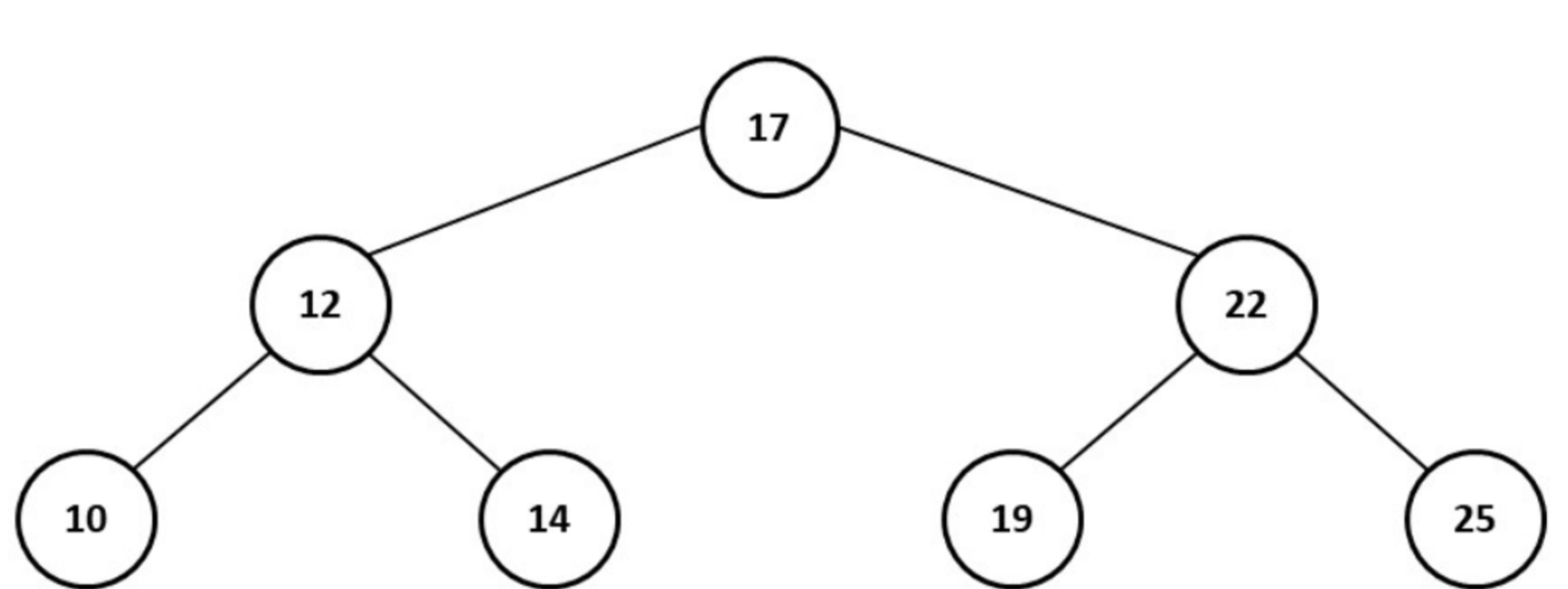
If the tree remains balanced, this property allows us to search, insert, and delete in \(O(\log n)\) time, making it immensely faster than scanning an array.
Search and Sorting
- Linear Search: Sequential checking of every element. Complexity is \(O(n)\).
- Binary Search: An extremely efficient search on sorted arrays (or Binary Search Trees). At each step, it halves the search space. Complexity is \(O(\log n)\).
- Sorting Algorithms: Common algorithms to organize data include Quicksort (\(O(n \log n)\)), Mergesort (\(O(n \log n)\)), Heap Sort (\(O(n \log n)\)), and the much slower Insertion Sort (\(O(n^2)\)).