Tree-Based Index Structures
Why Trees for Indexing?
The multilevel index from Section 1 was a good idea, but it had one major problem: as the file grows, overflow blocks pile up and performance degrades. You eventually need to reorganize the whole file — expensive and disruptive.
Tree-based structures solve this by self-balancing on every insert and delete, keeping search cost at \(O(\log n)\) always, without any manual reorganization.
The 2-3-4 Tree: Motivation
The problem with BSTs on disk is that each node holds only one key and has only two children. The tree must be very tall (\(O(\log n)\) levels) to hold \(n\) records.
What if we could make each node fatter — storing multiple keys and having multiple children? Then the tree would be much shorter, and we’d need far fewer disk reads to reach any record. This idea leads to the 2-3-4 Tree.
What Is a 2-3-4 Tree?
A 2-3-4 Tree is a balanced search tree where every node can hold 1, 2, or 3 keys (and correspondingly have 2, 3, or 4 children). That is where the name comes from.
The three node types:
| Node type | Keys stored | Children | Search key rule |
|---|---|---|---|
| 2-node | 1 (call it S) | 2 | left child < S; right child > S |
| 3-node | 2 (S and L) | 3 | left < S; middle: S–L; right > L |
| 4-node | 3 (S, M, L) | 4 | left < S; second: S–M; third: M–L; right > L |
A leaf node can hold 1, 2, or 3 data items.
Key properties:
- All leaves sit at the same depth — the tree is always perfectly height-balanced.
- \(h \sim O(\log n)\), so search, insert, and delete all cost \(O(\log n)\).
- Data is always kept in sorted order.
Search in a 2-3-4 Tree
Search is a straightforward extension of BST search. At each node, compare the target key against the node’s keys and follow the appropriate child pointer. Repeat until you reach a leaf or find the key.
💡 Because all leaves are at the same depth, every search takes exactly \(O(h) = O(\log n)\) steps — no worst-case skew possible.
Insertion in a 2-3-4 Tree
Insertion always happens at a leaf. The process:
- Search for the expected location (the leaf where the key would go).
- If the leaf is a 2-node, expand it to a 3-node and insert. Done.
- If the leaf is a 3-node, expand it to a 4-node and insert. Done.
- If the leaf is a 4-node, we can’t add another key — we must split it first.
Node Splitting
Splitting a 4-node takes its middle key (M) and pushes it up to the parent. The original 4-node becomes two 2-nodes (one holding S, one holding L), both children of the parent which now absorbs M.
There are three cases depending on the parent:
Case 1 — Parent is the root (a 4-node):
    [S  M  L]          [M]
   /  |  |  \    →    /   \
  a   b  c   d      [S]   [L]
                   / \   / \
                  a   b c   d
The tree grows one level taller.
Case 2 — Parent is a 2-node:
The middle key M is absorbed into the parent, converting it from a 2-node to a 3-node. The split 4-node’s two halves (S and L) become two separate children.
Case 3 — Parent is a 3-node:
Same idea — M is absorbed, converting the parent from a 3-node to a 4-node.
Early vs. Late Splitting
There are two strategies for when to split:
- Early splitting: Split any 4-node you encounter on the way down during a search, before you actually need to. This ensures you never have a full node at the insertion point. At most one split per level.
- Late splitting: Only split when you actually need to insert into a 4-node. May cascade up \(O(h)\) splits in the worst case.
Both strategies produce valid trees with the same complexity \(O(h)\), but they produce different final shapes. The slides follow the early splitting strategy.
Insertion Example: Step by Step
Inserting the sequence 10, 30, 60, 20, 50, 40, 70, 80, 15, 90, 100 using the early splitting strategy.
After inserting 10, 30, 60 — all three fit into one leaf (a 4-node):
[10 30 60]Insert 20 — the root is a 4-node, so we split it before descending. Middle key 30 becomes the new root; 10 and 60 become separate children. Then 20 is inserted into the left child:
        [30]
       /    \
  [10, 20]  [60]
Insert 50 — 50 > 30, go right. [60] is a 2-node, so just expand it:
        [30]
       /    \
  [10, 20]  [50, 60]
Insert 40 — 40 > 30, go right. [50, 60] is a 3-node, expand to 4-node and insert:
        [30]
       /    \
  [10, 20]  [40, 50, 60]
Insert 70 — root [30] is fine. 70 > 30, descend right. [40, 50, 60] is a 4-node — split it immediately (early strategy). Middle key 50 rises to join the root:
           [30, 50]
          /   |    \
   [10,20]  [40]  [60]
Now insert 70 into the right child [60]:
           [30, 50]
          /   |    \
   [10,20]  [40]  [60, 70]
Insert 80 — 80 > 50, go to right child [60, 70]. It’s a 3-node, expand it:
           [30, 50]
          /   |    \
   [10,20]  [40]  [60, 70, 80]
Insert 15 — 15 < 30, go left. [10, 20] is a 3-node, expand it:
              [30, 50]
             /   |    \
  [10, 15, 20]  [40]  [60, 70, 80]
Insert 90 — root [30, 50] is fine. 90 > 50, descend right. [60, 70, 80] is a 4-node — split it. Middle key 70 rises to join the root:
                [30, 50, 70]
               /   |    |   \
  [10,15,20]  [40] [60] [80]
Now insert 90 into the rightmost child [80]:
                [30, 50, 70]
               /   |    |   \
  [10,15,20]  [40] [60] [80, 90]
Insert 100 — root [30, 50, 70] is a 4-node — split it first. Middle key 50 becomes the new root; 30 and 70 become children:
                      [50]
                     /    \
                  [30]    [70]
                 /    \   /   \
          [10,15,20] [40] [60] [80,90]
Now insert 100. 100 > 50 → go right to [70]. 100 > 70 → go to right child [80, 90]. It’s a 3-node, expand it:
                      [50]
                     /    \
                  [30]    [70]
                 /    \   /   \
          [10,15,20] [40] [60] [80, 90, 100]
Final tree after all 11 insertions:
                         [50]
                        /    \
                     [30]    [70]
                    /    \   /   \
             [10,15,20] [40][60] [80,90,100]
Height = 2. All 11 keys stored, all leaves at the same level.
Deletion in a 2-3-4 Tree
Deletion is the reverse of insertion. The core idea:
- Locate the node containing the target key.
- Swap it with its inorder successor (the smallest key in the right subtree). This reduces deletion to always happening at a leaf.
- If the leaf is a 3-node or 4-node, simply remove the key.
- If the leaf is a 2-node, removing its only key would leave an empty node — which is illegal. To prevent this, transform every 2-node you encounter (on the way down) into a 3-node or 4-node first. This is the reverse of the splitting cases from insertion.
Deletion Example
We will delete 30 and then 50 from the final tree above.
Starting tree:
                         [50]
                        /    \
                     [30]    [70]
                    /    \   /   \
             [10,15,20] [40][60] [80,90,100]
Delete 30
30 is an internal node. Its inorder successor is 40 (smallest key in its right subtree). Swap 30 and 40:
                         [50]
                        /    \
                     [40]    [70]
                    /    \   /   \
             [10,15,20] [30][60] [80,90,100]
Now delete 30 from the leaf [30]. That leaf is a 2-node — but since 30 is the only key, removing it would leave an empty node.
However, looking at its sibling [10, 15, 20] (a 4-node), we can borrow from it. The sibling’s largest key (20) rotates up to the parent, and the parent’s key (40) rotates down to fill the now-empty spot:
                         [50]
                        /    \
                     [20]    [70]
                    /    \   /   \
             [10,15]  [40][60] [80,90,100]
30 is deleted. The tree remains balanced and all leaves are still at the same depth.
Delete 50
50 is the root. Its inorder successor is 60 (smallest key in its right subtree). Swap 50 and 60:
                         [60]
                        /    \
                     [20]    [70]
                    /    \   /   \
             [10,15]    [40][50] [80,90,100]
Now delete 50 from the leaf [50]. It is a 2-node with no siblings to borrow from (both [20] and [60] in the right subtree are also 2-nodes).
In this case, we merge: combine the 2-node [50] with its sibling [60] (oops — actually [60] is now the root, not a sibling). Let’s be precise: the right child of the root is [70], whose left child is [50] and right child is [80,90,100]. Since [50] is a 2-node and we must delete from it, we can borrow from the rich sibling [80, 90, 100]. The sibling’s smallest key (80) rotates up to the parent [70], and 70 rotates down to fill the gap:
                         [60]
                        /    \
                     [20]    [80]
                    /    \   /   \
             [10,15]    [40][70] [90,100]
50 is deleted. Final tree:
                         [60]
                        /    \
                     [20]    [80]
                    /    \   /   \
               [10,15]  [40][70] [90,100]
Still height 2, all leaves at the same depth.
📌 Key takeaway from deletion: The 2-3-4 tree never lets a node go empty. If you need to delete from a 2-node, you always first fatten it up — either by borrowing from a sibling or by merging with a sibling — before removing the key. This is the structural guarantee that keeps the tree balanced after every operation.
B+ Trees
ISAM (indexed-sequential files) degrades as the file grows — overflow blocks pile up and require periodic full reorganization. B+ trees fix this by self-balancing on every insert and delete.
With \(n = 100\) and 1 million records, B+ Tree needs 4 reads. A balanced BST on the same data needs ~20 disk reads. Each read costs ~20ms — the difference is significant at scale.
Structure
A B+ tree with parameter \(n\):
| Node | Min | Max |
|---|---|---|
| Internal (non-root) | \(\lceil n/2 \rceil\) children | \(n\) children |
| Root (non-leaf) | 2 children | \(n\) children |
| Leaf | \(\lceil (n-1)/2 \rceil\) values | \(n-1\) values |
| Root as leaf | 0 values | \(n-1\) values |
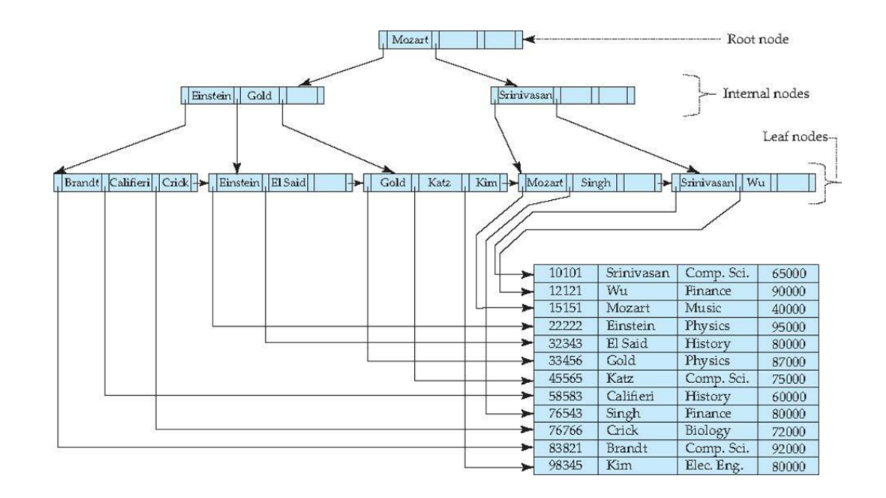
- All paths root → leaf are the same length.
- Keys in each node are ordered: \(K_1 \leq K_2 \leq \cdots \leq K_{n-1}\).
- Leaf nodes are linked → supports sequential (range) access.
- Leaf: \(P_i\) → record with key \(K_i\); last pointer \(P_n\) → next leaf.
- Internal: \(P_i\) → subtree. Keys in \(P_1 < K_1\); keys in \(P_i \geq K_{i-1}\) and \(< K_i\); keys in \(P_n \geq K_{n-1}\).
Search
To find value \(V\):
- Start at the root.
- At each internal node, scan the keys left to right and find where 𝑉 fits. Follow the pointer to the matching child subtree. Repeat until you reach a leaf.
- At the leaf, scan for 𝑉. If found, follow its pointer to the record. If not, the record doesn’t exist.
Duplicates: ordering relaxes to \(\leq\). Always descend \(P_i\) when \(V = K_i\) — duplicates may exist in the left subtree. To find all occurrences, traverse consecutive leaves via the linked list.
Insertion
- Find the target leaf and insert in sorted order.
- If space exists → insert. Done.
- If leaf is full → split:
- Put first \(\lfloor n/2 \rfloor\) pairs in original node, rest in new node.
- Push smallest key of new node up to parent.
- If parent is also full → split it and propagate upward.
- Worst case: root splits, tree grows one level taller.
Deletion
- Remove the record and its (key, pointer) from the leaf.
- Node still has enough entries → done.
- Underfull + can merge with sibling → combine into one node; pull separator key down from parent; recurse upward.
- Underfull + cannot merge → redistribute from sibling; update separator key in parent.
- If root ends up with one child → delete root, promote that child.
B-Tree vs B+ Tree
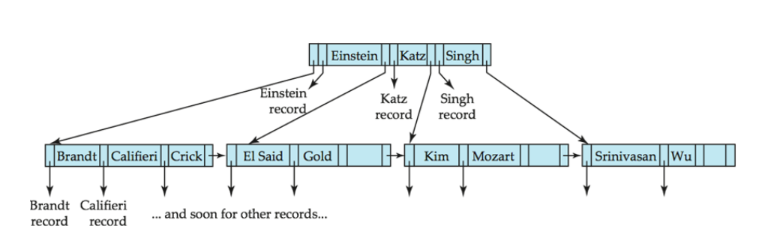
B-tree eliminates key duplication — each key appears once across the whole tree, with record pointers directly in internal nodes.
| B+ Tree | B-Tree | |
|---|---|---|
| Keys in internal nodes | Routing copies only | Actual record pointers |
| Key duplication | Yes | No |
| Leaf nodes linked | Yes | No |
| Fan-out | Higher | Lower |
| Sequential access | Efficient | Inefficient |
| Early key find | No | Sometimes |
| Complexity | Simple | More complex |